When I lived in Knoxville twenty years ago, I had a friend who worked at the West End Borders bookstore, and she took me in the staff break room once. I will never forget it because the staff had covered the walls in hilarious parodies of their customers and customers’ interests. There was a caricature of Bobby Drinnon, a well known local mystic that said, “I find that eating pieces of pictures of God helps me tune in and elevate my vibration.”

and there was a comic strip line of hundreds of elderly ladies asking for copies of Jan Karon novels in large print, which I found hilarious even though I had never read one. I knew they are super southern and about an Episcopal priest.
So the other day, I stumbled on a Jan Karon novel sticking out of one of our many disheveled bookshelves, and I thought, oh, that would be a break on my eyes because it didn’t occur to me that they released the books not in large print. LOL
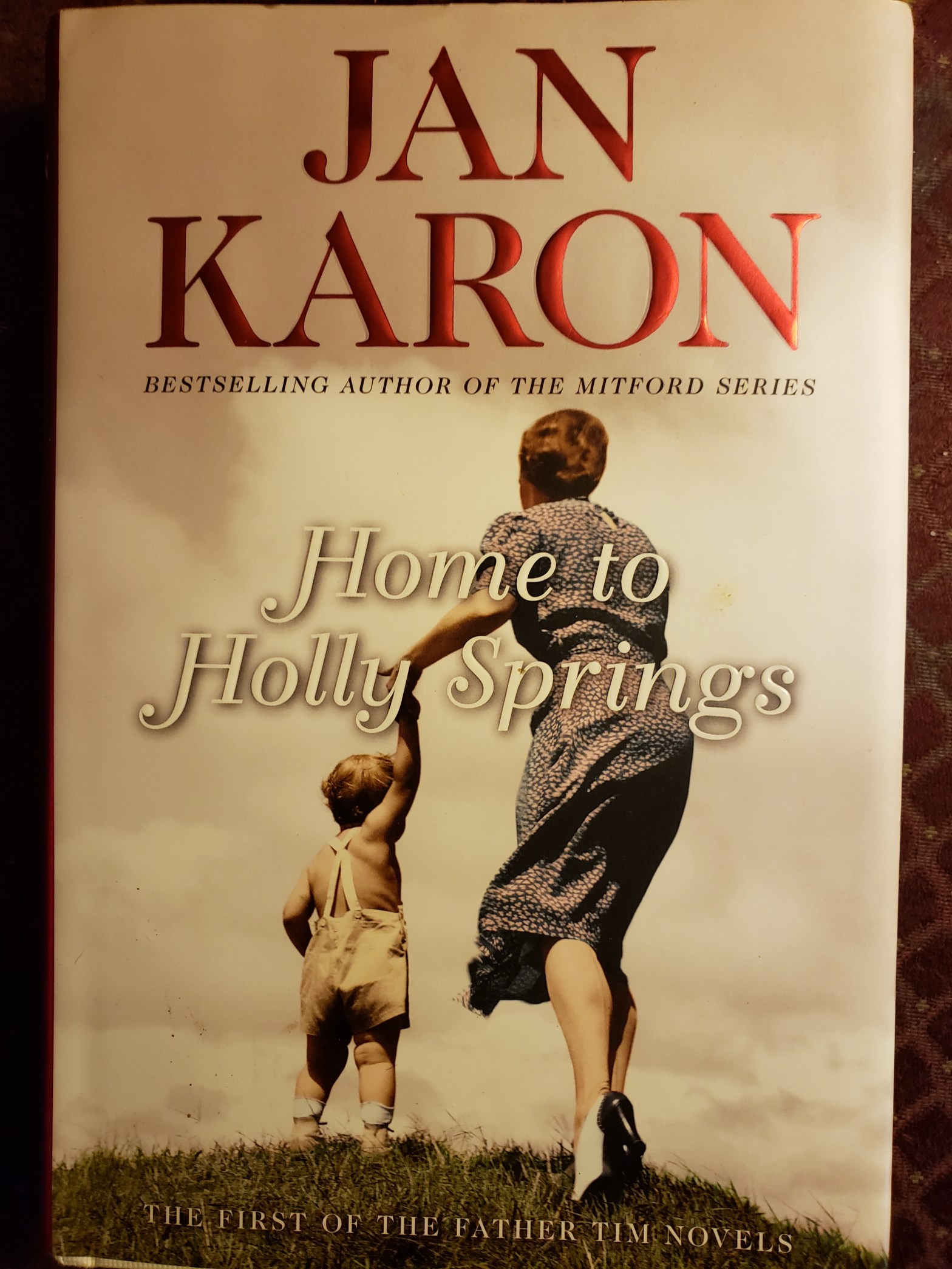
Well, unfortunately they do release them in regular print, but I am required to read one in my lifetime anyway because my father is an Episcopal priest, I have worked for the Episcopal church for twelve years and both my brother and father graduated from Sewanee (where Father Tim, the main character of a series of Jan Karon’s novels… also graduated from). It was easy to choose Home to Holly Springs because even though when I lived in Mississippi, I lived in Aberdeen, I spent a lot of time in Holly Springs at Junior Kimbrough’s juke joint, the establishment of the renown blues musician who passed in 1998 and was called the beginning and end of all music.

I continued to read Jan Karon’s novel, even though it had clearly never occurred to her (even though it was published in 2007) that a person of color might also like to read her novel and she should create certain character depictions with that in mind…but in spite of that rather substantial failing, I enjoyed its southernness that seems at times exaggerated, but I know from experience it isn’t. Father Tim receives an anonymous note in the mail at his home in North Carolina that just says, “Come Home.” Something in his spirit tells him he has to find out who has sent it, and so he returns home to Holly Springs for the first time in 38 years. You learn that he stayed away so long because of the difficult memories of his father that haunt him there. The first place Father Tim goes when he gets there is the cemetery to see his parents’ graves. This makes total sense to me. Graveyards can be so southern. While he is there, an elderly lady who remembers his family upbraids him for having left his heritage by abandoning the state of Mississippi. Credible. Then, a mysterious man in a straw hat and a seersucker suit sits down next to him near a tombstone and tells him he wants to talk to him about a mystery of his past regarding his father.
Now perhaps this seems improbable, but the exact same thing happened to me in Mississippi. I was at a pig roast hosted by the head of the Southern Studies Department at Ole Miss. We were discussing pouring bourbon on Faulkner’s grave around the corner from Eudora Welty’s house when a man in a seersucker suit and straw hat with a roasted pig leg in his hand sat next to me on the tombstone. It was Barry Hannah. I swear to God that is true. So I kept reading Jan Karon.

Barry Hannah did not unlock for me some long hidden mystery about my dad, but I’ll never forget it anyway.
Jan Karon provided me a romp down memory lane about the south, and I appreciate that, but I didn’t find the plot very interesting and I did find a lot of this novel highly problematic. I would be more specific, but my partner told me I revealed too many plot points in my last review so I’ll try to keep it snappy. When Jan Karon provides the big reveal about the mystery of Father Tim’s dad, I don’t buy it. I don’t buy it because she writes situations in Mississippi where black people and white people interact with each other in the absence of structural racism and power.

That would be like me telling you a nice scene from me hanging out at Junior Kimbrough’s juke joint, and failing to mention that I was a twenty-one year old white girl in a place where I had no business being, where I was likely not wanted, and where I was creating a life threatening situation for many people there simply because I was too ignorant and entitled to know or care. I was there because I was with a white man who was studying the Blues at the university, and black musicians were regularly subjected to the presence of anthropologists who study music like the cultural artifacts of cultures in ongoing genocides because that’s what degrees are made of. I could tell you that I had a lovely time at Junior Kimbrough’s, and we all got along, and now you know what it’s like to read the Jan Karon novel.
It’s not all bad. Father Tim does have a dog that looks like this.

The dog shows up in almost every scene. His name is Barnabas, and if Jan Karon hadn’t written him, I wouldn’t have googled what an Irish Wolf Hound looks like and then I wouldn’t have known that there is a dog Hogzilla like this one and my life would be less for that.
Ok, Ok. You never did google Hogzilla, did you…..even though I told you we could talk about it for hours. Well then, here is my parting gift to you in this review. In 2004, this thing was roaming around in the woods behind a Walmart in Alabama.

It was scientifically verified. According to my more than hour long conversation with a former pig farmer who was working as an exterminator trying to rid my house of rats, Hogzilla might not have been a wild boar; he may have been a domesticated pig that was purposefully force fed thousands of pounds of corn to get him to reach this gargantuan size, but does that really make this story less interesting? Does it make it any less bizarre? Does it really not rip the top of your head off and make you question all the things you told yourself could never be possible in the physical world?
Jan Karon may want you to come away from reading her novel with a deeper connection in your heart to the love Christ can awaken in you, but I want you to come away from reading this review, enlivened and intrigued by ideas about what might be living out back behind a Walmart near you.
You’re welcome.
 Inspiration and Information for Immigrant Advocacy
My mother was a huge Jan Karon fan and had me read several of her books, all of which seemed like eating pablum. Not very satisfying, but harmless. So, when the Georgia Center for the Book had a session with Karon at the huge Baptist church in Decatur, we went to see her. She lost me when she started telling us she was moved to write these novels by the voice of God. Really?
LikeLike
I very much enjoyed reading this comment. I did feel when I was reading like a big motivation for her was evangelism which you have confirmed. If people feel uplifted by that, great.
LikeLike